
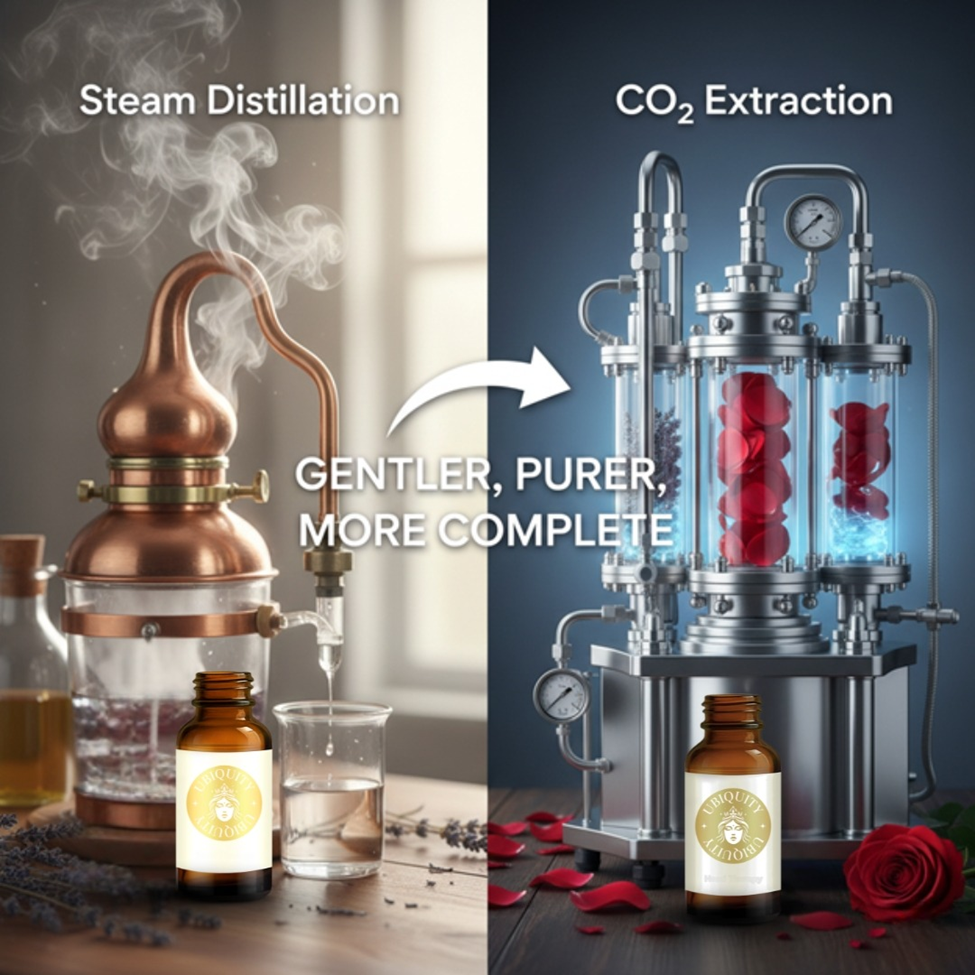
Most of us enjoy essential oils without ever thinking about how they’re made, yet the extraction method can completely change their scent and quality. For a long time, steam distillation was the go-to method. Plants were heated with steam until their aromatic compounds rose and condensed into oil. It works much like boiling herbs and capturing the scented vapor but the heat involved can change or destroy delicate molecules. The end result is still an essential oil, just not always a perfect reflection of the fresh plant. Some of the scent can shift, and certain natural benefits may fade in the process.
Critical CO₂ extraction, however, takes a much gentler approach. Instead of heat, it uses carbon dioxide under special pressure to pull out the plant’s aromatic compounds. In this state, the CO₂ acts like a clean, cool solvent that leaves the plant’s chemistry intact. Once the pressure is released, the CO₂ evaporates back into gas, leaving behind a pure oil that smells and behaves remarkably close to the actual plant often richer, fresher, and more vibrant.
Because no high heat is involved, CO₂ extraction captures a broader range of beneficial compounds. This makes the oil feel more complete and often more effective, especially for skincare or aromatherapy. People with sensitive skin also tend to find CO₂-extracted oils gentler, since none of the plant’s components are overheated or altered.
Steam distillation still has its place, especially for sturdy plants, and it keeps oils affordable. But when the goal is to experience a plant in its most natural and full-bodied form, CO₂ extraction stands apart. It’s like the difference between sun-dried herbs and ones frozen at peak freshness both useful, but one captures the plant exactly as nature intended.